

Avoiding the “90°F Saturday” Breakdown

In Cedar Rapids, we’re no strangers to the Midwest Snap—that week in late May or early June when the thermometer suddenly jumps from a pleasant 70°F to a punishing 90°F with humidity to match. While we’re busy planning our first backyard BBQ or heading to the Downtown Farmers Market, our air conditioners are about to face their most brutal stress test of the year.
The first major heatwave is the most dangerous time for your HVAC system. After sitting idle for months, a system that seemed fine last September can suddenly fail under the pressure of a 90°F Saturday. At Colony, we want to help you avoid the emergency repair call.
Here are the five red flags that your air conditioning isn’t ready for the Iowa summer, and how a professional spring tune-up keeps you out of the heat.
Weak Temperature Split
The most technical way to tell if your AC is struggling is by measuring the Temperature Split. This is the difference between the temperature of the air going into your return vents and the air blowing out of your supply vents.
The Math: For a healthy system, you should see a 16°F to 20°F difference.
- If your house is 75°F, the air coming out of the vent should be between 55°F and 59°F.
If that split is only 10°F or 12°F, your system is running, but it isn’t actually cooling. This is often a sign of low refrigerant or a dirty evaporator coil. Without that 20-degree gap, your AC will run 24/7, driving up your utility bill without ever making the house comfortable.
Visible Winter Debris on the Unit
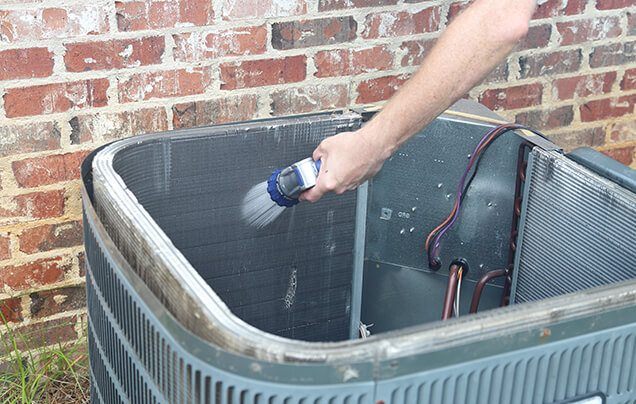
Your outdoor unit is responsible for releasing the heat it pulled from your home. During an Iowa winter, it becomes a magnet for dead leaves, twigs, and—most commonly in Cedar Rapids—cottonwood seeds.
If the aluminum fins on your outdoor unit are covered in debris, the heat has nowhere to go. This causes the compressor to overheat and can lead to a total system shutdown on the hottest day of the year. Maintain at least 2 feet of clear space around your unit and gently hose off any visible dirt (with the power off!).
Restricted Airflow
If you notice a puff of dust every time the AC kicks on, or if your home feels stuffy despite the air moving, you have an airflow crisis. After a long winter of the furnace running, your filters are likely at maximum capacity.
A clogged filter doesn’t just impact air quality; it creates a “vacuum” effect that strains the blower motor. In the spring, this restricted airflow often causes the indoor evaporator coil to drop below freezing, leading to frozen coils. If you see ice on your copper refrigerant lines in June, a dirty filter is almost always the culprit.
Unusual Post-Hibernation Noises
When you first switch from “Heat” to “Cool” on your thermostat, listen closely. Your system shouldn’t sound like a bag of marbles or a jet engine.
- Squealing: Often a sign of a slipping fan belt or a bearing that has dried out over the winter.
- Banging: Suggests something has come loose or a motor mount has failed.
- Clicking: If the outdoor unit clicks repeatedly but won’t start, your capacitor is likely failing.
In the HVAC world, noise is a symptom. Ignoring a small rattle in May usually leads to a large replacement in July.
Short-Cycling
If your AC turns on, runs for three minutes, and shuts back off—only to repeat the process ten minutes later—it is short-cycling. This is incredibly hard on your system’s compressor.
Short-cycling is often caused by an oversized system or a thermostat that is miscalibrated, but in the spring, it’s frequently a sign that the system is tripping a safety switch due to overheating or pressure issues. A system that short-cycles will never properly dehumidify your home, leaving you feeling clammy even if the temperature is lower.
How a Spring Tune-Up Prevents the Breakdown
A professional spring maintenance visit from Colony isn’t just a cleaning—it’s a precision calibration. Our technicians perform a multi-point inspection designed to catch these 5 signs before they become failures:
- Electrical Tightening: We check connections that may have loosened during the temperature swings of an Iowa winter.
- Refrigerant Level Check: We ensure your Temperature Split is exactly where it needs to be.
- Component Testing: We test capacitors and motors to ensure they can handle the start-up surge of a hot afternoon.
- Drain Line Clearing: We flush the condensate drain to prevent water damage caused by algae clogs (the #1 cause of “water in the basement” calls in summer).
Trust the Math, Not the Guesswork
Don’t wait until the first 90°F Saturday to find out your AC is killing your comfort. By verifying your system’s performance now, you ensure that when the Iowa humidity hits, your home remains a cool sanctuary.
Is your AC ready for the July heat? Call Colony Plumbing, Heating and Air Conditioning today to schedule your precision spring tune-up and breathe easy all summer long!
