

Avoiding the “Bigger is Better” Trap
In the world of HVAC, a dangerous misconception persists: the idea that a larger furnace will heat your home faster and more effectively. In reality, an oversized system is a leading cause of equipment failure and high energy bills.
The U.S. Department of Energy reports that up to 93% of residential systems are oversized, often because contractors “size up” to avoid callbacks rather than performing the necessary engineering. For an Iowa homeowner, this error isn’t just a technicality—it directly impacts your wallet and your comfort during the most brutal months of the year.
Understanding the “Goldilocks Principle”
An HVAC system must be perfectly suited to its environment to operate efficiently.
- Undersized Systems: These units run endlessly without ever reaching your thermostat’s set temperature. In a Cedar Rapids winter, an undersized furnace faces a 100% duty cycle, leading to massive utility spikes and premature mechanical failure.
- Oversized Systems: These reach the set temperature too quickly and shut off—a process called “short-cycling”. This rapid on-and-off movement prevents the system from reaching its optimal operating temperature, which can cause the heat exchanger to crack over time and lead to uneven “hot and cold spots” throughout the house.
- Just Right: A system sized through a professional Manual J certified Load Calculation. This is not a rule of thumb approach or simply assuming the original furnace size is correct.

Why Load Calcs Matter: The Science of Heat Transfer
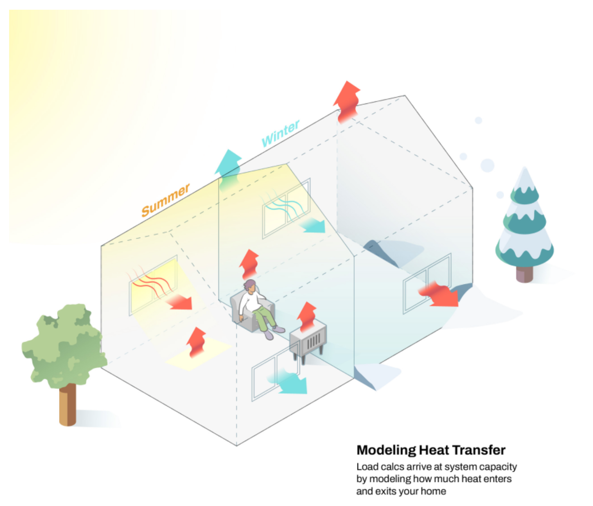
To find that “Just Right” size, professionals must perform a Load Calculation, a rigorous standard developed by the Air Conditioning Contractors of America (ACCA). This process models Heat Transfer—the exact measure of how much heat your home loses to the freezing Iowa air in the winter.
A proper load calculation considers specific factors unique to your property:
- The Building Envelope: The insulating R-values of your attic, walls, and floors.
- Fenestration: The orientation, size, and “U-factor” of your windows.
- Internal Heat Gains: The number of occupants and heat-producing appliances like ovens or electronics.
- Climate Data: Using “Winter Outside Design Temperatures” (the temperature that it only drops below 2.5% of the time in your specific area).
Precision Measurement with LiDAR Technology
Historically, load calculations involved manual measurements that were prone to human error. Today, contractors use LiDAR technology to measure walls, windows, and ceilings with millimetre precision. By using advanced tools and technology the folks at Colony can generate a 3D model that captures every structural detail without recording any personal information.
This 3D data tells us exactly how many BTUs (British Thermal Units) your home needs. Accurate mapping reduces guesswork, ensuring the equipment is right-sized from day one to prevent the 30% energy waste associated with improper installations.
The 10-Step Education Checklist
When an installation is performed correctly, it follows a rigorous sequence:
- Load Calculation: Establishing the scientific heating requirements.
- Proper Equipment Selection: Matching furnace capacity to the calculated load.
- Duct Sizing Verification: Ensuring your existing “vascular system” can handle the air volume.
- Airflow Checks: Measuring static pressure within the system.
- Refrigerant & Gas Pressure Calibration: Essential for safe and efficient combustion.
- Electrical Capacity Verification: Confirming your home can safely power the new equipment.
- Smart Control Calibration: Ensuring your thermostat is reading room temperatures accurately.
- System Commissioning: Testing the unit through multiple cycles to verify performance.
- Record Keeping: Giving you the digital records of the scan and load calculation for your files.
- Homeowner Education: Taking the time to explain how to change filters and maximize your new system’s life.
Your Partner in Home Health
Replacing a furnace is one of the most significant investments you’ll make for your home. By moving away from “rough estimates” and toward data-driven engineering, you ensure your home stays comfortable during an Iowa polar vortex without wasting a dime on unnecessary energy costs. Don’t leave it to a contractor who takes shortcuts. Trust the data, trust the technology, and trust the guys who take the time to do the math.
